If you are running a blog or planning to start one, one of the first questions that comes to mind is: “How much money can my blog actually make?”
For bloggers who monetize their traffic using Google AdSense, the most accurate way to answer this question is by understanding RPM and using an AdSense RPM Calculator.
Many beginners focus only on traffic numbers, but professional bloggers know that traffic alone does not pay the bills. What truly matters is how well that traffic is monetized. This is where RPM becomes a game-changing metric.
In this complete guide, you will learn everything about AdSense RPM, starting from absolute basics and gradually moving to advanced monetization strategies. By the end of this article, you will be able to estimate your blog earnings accurately, choose profitable niches, and improve your AdSense income strategically.
What Is AdSense RPM? (Explained for Beginners)
RPM stands for Revenue Per Mille, where mille means one thousand. In simple terms, RPM tells you how much money you earn for every 1,000 pageviews on your website.
Instead of focusing on individual ad clicks or impressions, RPM gives you a big-picture overview of your blog’s earning performance.
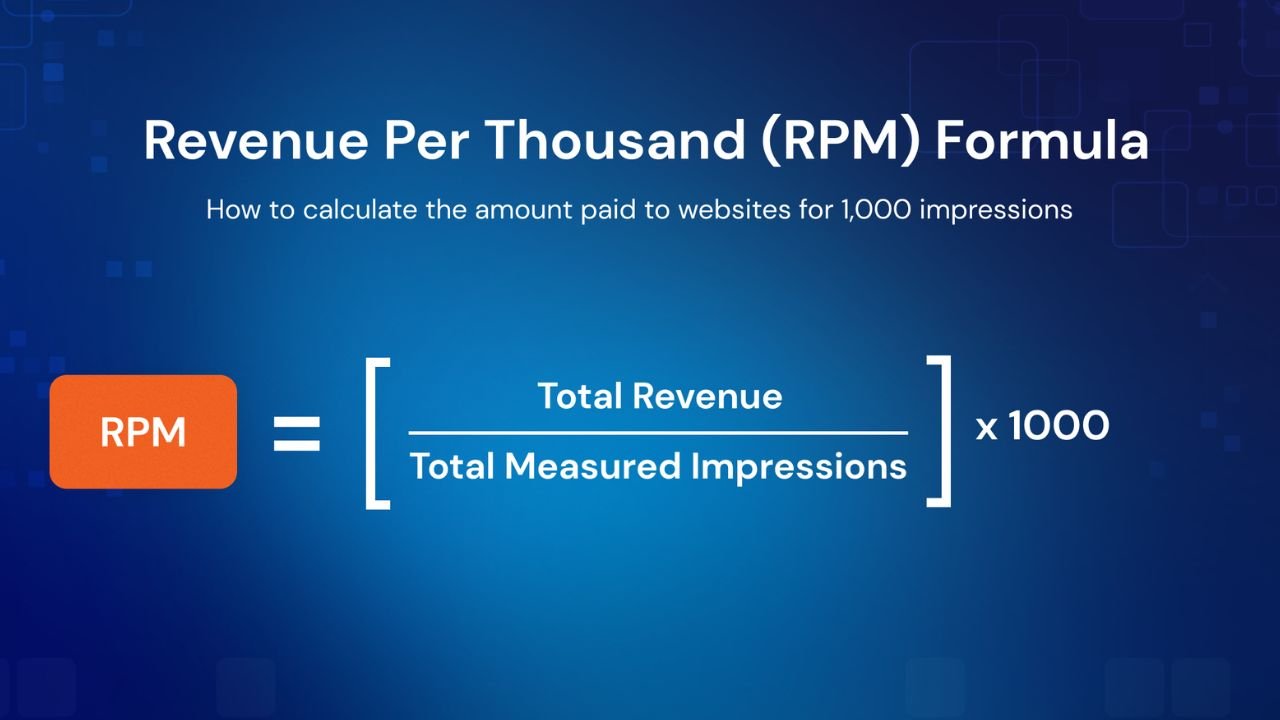
The standard formula for calculating RPM is:
RPM = (Total Earnings ÷ Total Pageviews) × 1,000
Simple Example
If your blog earns $20 from 10,000 pageviews, your RPM would be:
RPM = (20 ÷ 10,000) × 1,000 = $2
This means that for every 1,000 visitors, your blog earns $2.
This single metric helps bloggers understand whether their content, niche, and traffic quality are profitable or not.
Why RPM Is More Important Than Traffic
Many new bloggers believe that increasing traffic automatically increases income. While traffic is important, RPM determines how valuable that traffic is.
For example:
- Blog A gets 100,000 pageviews with an RPM of $2
- Blog B gets 20,000 pageviews with an RPM of $25
Even with much less traffic, Blog B earns more money.
This is why professional bloggers focus on increasing RPM first, then scaling traffic. High RPM allows you to earn more with fewer visitors, making your blogging business more sustainable.
What Is an AdSense RPM Calculator?
An AdSense RPM Calculator is a simple calculation method or tool that helps you estimate how much money your blog can earn based on:
- Your average RPM
- Your daily, monthly, or yearly pageviews
It allows bloggers to:
- Forecast future income
- Set realistic earning goals
- Compare niches before starting a blog
- Understand the impact of traffic growth
You don’t need any paid software to calculate RPM. Even a simple formula or spreadsheet works perfectly.
AdSense RPM Calculator Formula (With Explanation)
To estimate earnings, you use the reverse RPM formula:
Estimated Earnings = (RPM × Total Pageviews) ÷ 1,000
Beginner Example
Suppose your blog has:
- RPM: $5
- Monthly pageviews: 30,000
Your estimated monthly income would be:
(5 × 30,000) ÷ 1,000 = $150
This tells you that even a small improvement in RPM can significantly increase your income without increasing traffic.


Understanding RPM vs CPC vs CTR (Important for SEO Monetization)
To fully understand RPM, you must also know how it differs from CPC and CTR.
CPC (Cost Per Click) refers to how much advertisers pay for one ad click.
CTR (Click-Through Rate) measures the percentage of users who click on ads.
RPM, on the other hand, combines CPC, CTR, ad impressions, traffic quality, and niche value into one powerful metric.
This is why RPM is considered the most reliable monetization metric for AdSense publishers.
Average AdSense RPM by Niche (Realistic Estimates)
Different niches have very different RPMs because advertisers bid more in industries where customer value is high.
For example:
- Finance, insurance, and legal niches usually have very high RPMs because advertisers make more money per customer.
- Entertainment and viral content usually have low RPMs because advertiser intent is weaker.
A blog in the finance niche may earn $30–$50 RPM, while an entertainment blog may struggle to reach $3 RPM, even with massive traffic.
This is why niche selection is one of the most important decisions in blogging.
How Traffic Source Impacts Your AdSense RPM
Not all traffic is equal in the eyes of advertisers.
Traffic coming from Google search usually has the highest RPM because users are actively searching for solutions. This is why SEO traffic converts better than social media or viral traffic.
Traffic from Tier-1 countries like the United States, United Kingdom, Canada, and Australia also has much higher RPMs because advertisers in these countries spend more money on ads.
If your traffic is mainly from low-CPC countries, your RPM will naturally be lower—even with high pageviews.
Country-Wise RPM Difference (Why Location Matters)
Advertisers bid differently depending on audience location. A user from the USA is worth much more to advertisers than a user from a developing country.
For example:
- A blog with US traffic may earn $20+ RPM
- The same blog with Indian traffic may earn $2 RPM
This is why many professional bloggers target global or US-based audiences for maximum AdSense earnings.
How to Increase Your AdSense RPM (Advanced Strategies)
Increasing RPM is not about placing more ads randomly. It is about improving content value and user intent.
High-RPM blogs focus on:
- Long-form, in-depth articles
- Commercial and informational keywords
- User experience and site speed
- Strategic ad placement
- High-value evergreen topics
Google rewards websites that provide helpful, trustworthy, and original content. Improving content quality often increases RPM naturally over time.
Estimating Monthly and Yearly Blog Income Using RPM
Once you know your RPM, income forecasting becomes simple.
If your blog has:
- RPM: $10
- Monthly pageviews: 50,000
Your estimated income is:
(10 × 50,000) ÷ 1,000 = $500/month
That translates to $6,000 per year.
Now imagine increasing RPM to $20 without increasing traffic—your income doubles instantly.
This shows why RPM optimization is more powerful than chasing traffic alone.
Common Mistakes That Reduce AdSense RPM
Many bloggers unknowingly reduce their RPM by:
- Publishing thin or duplicate content
- Overloading pages with ads
- Targeting low-intent keywords
- Ignoring mobile optimization
- Using slow or poorly designed themes
Google prioritizes user experience, and poor UX often leads to lower ad bids and reduced RPM.
AdSense RPM vs Affiliate Marketing: Which Is Better?
AdSense RPM works best for informational content and blogs with consistent traffic. Affiliate marketing works better for buyer-intent content.
The most successful bloggers often combine both:
- AdSense for passive income
- Affiliate links for high-ticket conversions
This hybrid strategy maximizes total revenue per visitor.
Why Every Blogger Should Use an AdSense RPM Calculator
An AdSense RPM Calculator is not just a tool—it is a decision-making framework. It helps you understand your blog as a business rather than a hobby.
By tracking RPM, you can:
- Predict earnings accurately
- Choose profitable niches
- Improve content strategy
- Scale your blog sustainably
Remember, traffic brings visitors, but RPM determines value.